
Degenerative Disc Disease
Degenerative Disc Disease Treatment in Anchorage, AK
Degenerative disc disease can make activities that once felt effortless increasingly uncomfortable. Sitting at work, standing for long periods, getting out of bed, driving, bending, lifting, exercising, or simply turning your head may become harder when the discs and surrounding structures of your spine are no longer functioning as comfortably as they once did.
At Whole Family Chiropractic in Anchorage, AK, we help patients dealing with degenerative disc disease, chronic back pain, neck pain, stiffness, sciatica, and other disc-related problems understand what may be contributing to their symptoms and what treatment options may be appropriate.
Our approach goes beyond simply chasing pain. We evaluate your spinal movement, posture, neurological symptoms, previous injuries, daily activities, and structural alignment so we can create a personalized plan designed to improve mobility, reduce irritation, and support better spinal function.
What Is Degenerative Disc Disease?
Degenerative disc disease, sometimes called degenerative disk disease or DDD, describes age-related and wear-related changes that occur within the spinal discs. Despite its name, it is not technically a disease. Some degree of disc degeneration is common as people get older, and many people have degenerative changes without experiencing significant pain.
The spinal discs sit between the vertebrae and help absorb forces while allowing the spine to bend, twist, and move. Over time, discs may gradually lose hydration, flexibility, and height. Small tears or changes in the outer portion of a disc can also develop.
Degenerative changes most commonly affect the lumbar spine in the lower back and the cervical spine in the neck. Symptoms can vary considerably depending on the location of the degeneration and whether surrounding joints, muscles, or nerves are also involved.
Common Degenerative Disc Disease Symptoms
Some people have degenerative changes on an X-ray or MRI without experiencing noticeable symptoms. Others may develop chronic or recurring discomfort.
Common symptoms may include:
- Lower back pain or stiffness
- Neck pain or stiffness
- Pain that comes and goes
- Pain that worsens after prolonged sitting or standing
- Discomfort with bending, twisting, or lifting
- Reduced spinal flexibility or mobility
- Pain traveling into the buttocks or legs
- Pain traveling into the shoulder or arm
- Numbness, tingling, or burning sensations when nerves are irritated
- Muscle weakness when significant nerve involvement is present
Symptoms may be mild and occasional or become more persistent over time.
Because degenerative changes are common, finding degeneration on an X-ray or MRI does not automatically mean it is the sole cause of your symptoms. A thorough evaluation can help determine whether your discomfort may also involve joint mechanics, irritated nerves, postural changes, muscle imbalance, previous injuries, or other factors.
When Degenerative Disc Disease Starts Affecting Your Life
Chronic disc-related pain can gradually change the way you live without you realizing how many adjustments you have made.
You may avoid certain exercises because your back feels vulnerable, frequently change positions at work, struggle through long drives, wake up stiff in the morning, or hesitate before lifting something because you are worried about aggravating your symptoms.
For active Anchorage residents, degenerative disc problems may also interfere with hiking, skiing, fishing, hunting, working outdoors, going to the gym, shoveling snow, or simply keeping up with your family.
Getting older does not mean you should automatically accept persistent back or neck pain as something you simply have to live with.

Degenerative Disc Disease Relief in Anchorage
At Whole Family Chiropractic, our chiropractors in Anchorage evaluate more than the location of your discomfort. We look at spinal movement, posture, neurological symptoms, previous injuries, daily activities, and structural patterns that may be placing additional stress on affected areas of your spine.
Depending on your findings, your care plan may include traditional chiropractic care, advanced corrective chiropractic, physical rehabilitation, cervical or lumbar disc decompression, traction-based therapies, supportive therapeutic modalities, or a combination of approaches available within our Anchorage clinic.
Degenerative changes themselves cannot simply be erased, and our goal is not to promise that an aging spinal disc can be made new again. Instead, we focus on identifying factors that may be contributing to your symptoms and determining which conservative approaches may help improve movement, function, and comfort.
Chiropractic Care for Degenerative Disc Disease
Traditional chiropractic care may be recommended when restricted joint movement, stiffness, and impaired mobility appear to be contributing to your symptoms.
Whole Family Chiropractic uses multiple chiropractic techniques, allowing our doctors to adjust care based on the patient, location of the problem, comfort level, health history, and clinical findings.
Some patients may benefit from traditional adjustments, while others may require gentler or low-force techniques. When degeneration is accompanied by significant disc narrowing, nerve irritation, arthritis, or other structural changes, not every patient should be treated in the same way.
Your chiropractor will determine whether an adjustment is appropriate and which techniques should be used.
Cervical and Lumbar Disc Decompression
Whole Family Chiropractic offers both cervical intervertebral disc decompression and lumbar intervertebral disc decompression as part of our physical medicine services.
Disc decompression is a non-surgical approach designed to gently reduce mechanical pressure in targeted areas of the spine. Depending on your condition, it may be incorporated into a broader care plan for patients experiencing degenerative disc disease, disc-related back or neck pain, bulging or herniated discs, sciatica, or certain forms of nerve irritation.
For patients whose symptoms worsen with spinal compression or prolonged weight-bearing positions, decompression may provide another conservative option within a comprehensive treatment plan.
Your doctor will determine whether spinal decompression is appropriate after evaluating your symptoms and clinical findings.
Advanced Corrective Chiropractic with Chiropractic BioPhysics
For patients whose degenerative disc symptoms occur alongside significant postural or structural changes, our team may recommend advanced corrective chiropractic care using Chiropractic BioPhysics® (CBP).
CBP focuses on spinal alignment, posture, and biomechanics rather than symptoms alone. When clinically appropriate, your evaluation may include diagnostic X-rays and postural analysis to identify structural patterns that could be placing additional mechanical stress on areas of the spine.
For example, altered spinal curves, forward head posture, or other postural changes may affect how forces are distributed throughout the neck and back.
A customized corrective plan may incorporate Mirror Image® adjustments, corrective exercises, traction, and home recommendations designed around your individual findings.
Disc Rehabilitation and Supportive Care
When back or neck pain persists, your body may begin changing the way it moves to avoid discomfort. Muscles can become tight or weak, movement patterns may change, and certain everyday activities may become increasingly difficult.
Depending on your needs, care may include physical rehabilitation and supportive therapies available within our Anchorage clinic.
Whole Family Chiropractic offers a comprehensive physical medicine program that can incorporate chiropractic care, spinal rehabilitation, traction, posture correction, therapeutic modalities, and home recommendations based on each patient’s individual needs.
Our goal is to help you move more comfortably, improve function, and remain as active as possible despite degenerative changes in your spine.
Degenerative Disc Disease, Arthritis, and Herniated Discs
These conditions can occur together, but they are not exactly the same.
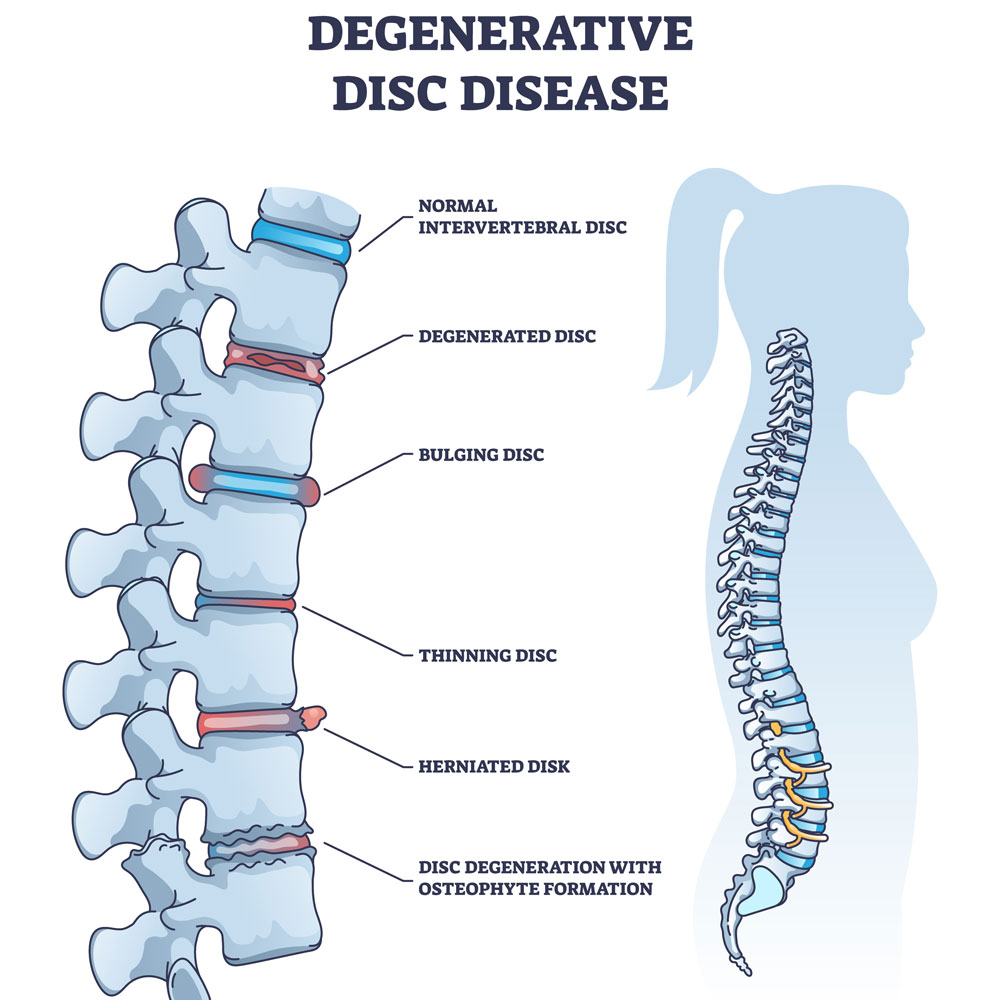
Degenerative disc disease describes changes occurring within the spinal discs, including loss of hydration, flexibility, and disc height. Spinal arthritis, or osteoarthritis, involves degenerative changes affecting joints and surrounding structures of the spine. A herniated disc occurs when material from within a spinal disc pushes through a weakened or damaged portion of its outer layer.
Degenerative disc changes can sometimes occur alongside arthritis, disc bulging, herniation, spinal stenosis, or nerve irritation. However, having degenerative disc disease does not automatically mean you have all of these conditions.
That is why an accurate evaluation matters. Two people may both have degenerative changes visible on imaging while experiencing completely different symptoms and requiring different approaches to care.
When Degenerative Disc Symptoms Need Urgent Medical Attention
Most degenerative disc disease symptoms are not medical emergencies, but certain neurological changes should always be taken seriously.
Seek urgent medical attention if you develop new loss of bladder or bowel control, numbness around the groin or inner thighs, rapidly worsening muscle weakness, significant loss of coordination, or severe neurological symptoms that make standing or walking difficult.
Back or neck pain following significant trauma, or pain accompanied by other serious or unexplained symptoms, should also receive appropriate medical evaluation.
Frequently Asked Questions
Can a chiropractor help with degenerative disc disease?
Chiropractic care may be one component of conservative care for some patients experiencing back or neck pain associated with degenerative changes. Whether chiropractic treatment is appropriate depends on your symptoms, location and severity of the degeneration, neurological findings, health history, and examination results. At Whole Family Chiropractic, each patient is evaluated individually before treatment is recommended.
Can degenerative disc disease be reversed?
Degenerative changes that have already occurred within a spinal disc generally cannot simply be reversed or restored to their original condition. However, having disc degeneration does not necessarily mean you will always have pain. Conservative care may focus on improving mobility, reducing contributing mechanical stress, strengthening supporting muscles, and helping you manage symptoms so you can remain active.
Is degenerative disc disease the same as a herniated disc?
No. Degenerative disc disease describes changes that occur as spinal discs gradually lose hydration, flexibility, or height. A herniated disc occurs when material inside a spinal disc pushes through a damaged or weakened portion of its outer layer. Disc degeneration may increase the likelihood of other disc changes, but the conditions are not identical.
Can degenerative disc disease cause sciatica?
It can. Degenerative changes in the lumbar spine may sometimes contribute to conditions that irritate or compress a spinal nerve. When the nerves contributing to the sciatic nerve are affected, symptoms may include pain, tingling, numbness, burning, or weakness traveling from the lower back or buttock into the leg.
Do I need an MRI for degenerative disc disease?
Not every patient needs an MRI. Your evaluation begins with your symptoms, health history, movement, neurological findings, and other appropriate clinical tests. X-rays can provide useful information about spinal alignment, disc-space narrowing, arthritis, and other structural changes. An MRI may be recommended when the spinal discs, nerves, and other soft tissues need to be evaluated in greater detail.
Does degenerative disc disease always get worse?
Not necessarily. Degenerative changes are a common part of aging, but imaging findings do not always match the severity of a person’s symptoms. Some people have substantial degenerative changes with little discomfort, while others experience recurring symptoms. Staying active, maintaining strength and mobility, and appropriately managing contributing factors can play an important role in long-term function.
Ready to get help with degenerative disc disease?
If you are searching for degenerative disc disease treatment in Anchorage, a chiropractor for degenerative disc disease, spinal decompression in Anchorage, or help with chronic back pain, neck pain, sciatica, or disc-related symptoms, Whole Family Chiropractic is here to help you understand your options.
Our team will evaluate your condition, explain what we find, and recommend the type of care that makes sense for your symptoms, lifestyle, and goals.
Looking for a great family chiropractor in Anchorage?
Contact us today at 907-562-3060 for an appointment
Whole Family
Chiropractic
Office Hours
Monday, Wednesday & Friday
8:30am – 6pm
Tuesday & Thursday
2pm – 6pm
Saturday & Sunday
Closed